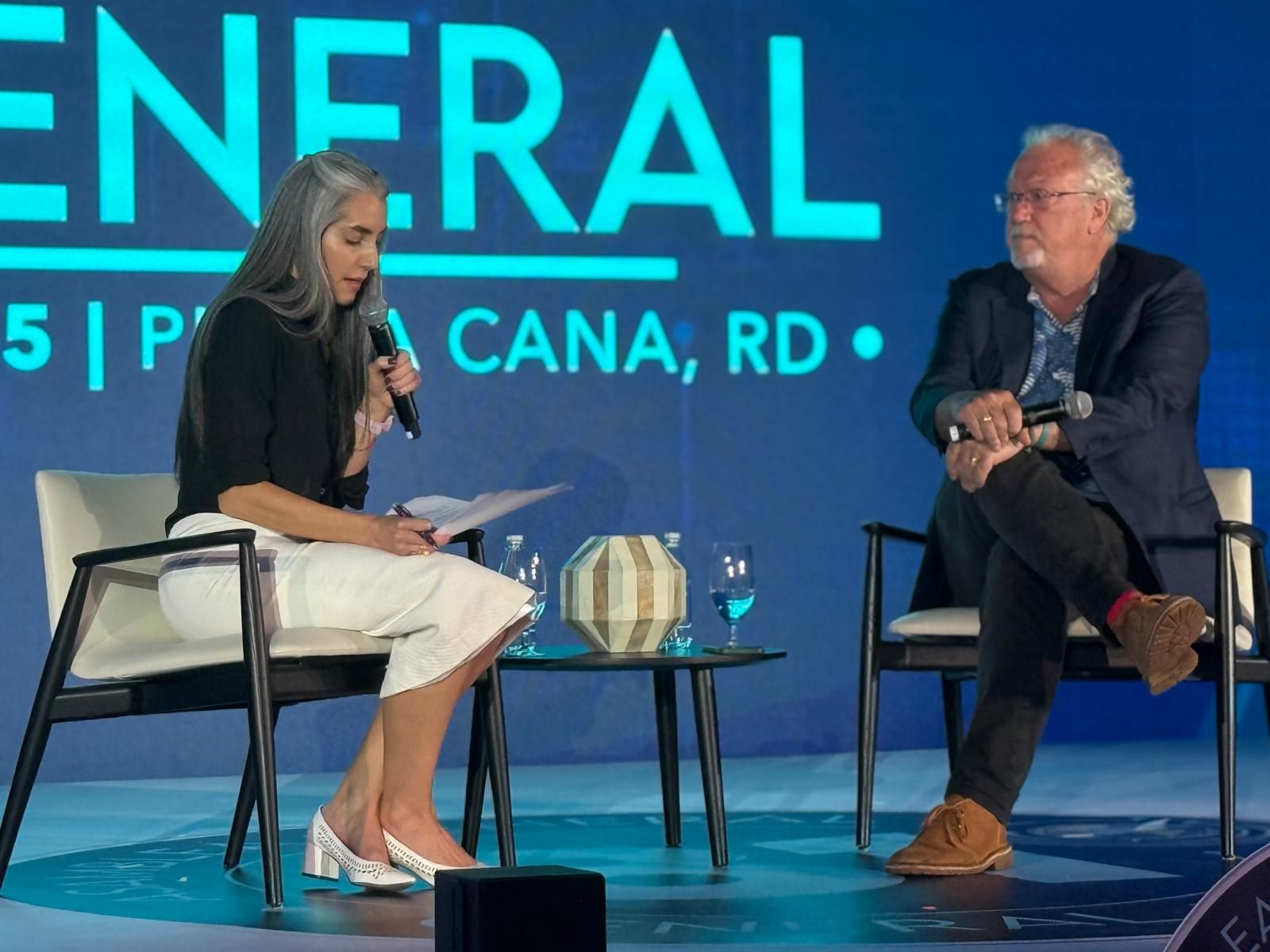
Journalist and chronicler John Lee Anderson kicked off the discussions on the future of journalism and democracy in Latin America during the 81st General Assembly of the Inter-American Press Association (IAPA). Interviewed by Gabriela Vivanco, chair of the IAPA Executive Committee and national director of the Ecuadorian newspaper La Hora, he addressed the rise of authoritarian regimes, the role of political symbols, the impact of organized crime, and the fragility of states in the region.
Anderson is the author of profiles of figures such as Fidel Castro, Hugo Chávez, Evo Morales, and Jair Bolsonaro. With the context provided by a professional life spent following these types of regimes, he traced the birth, consolidation, and fall of modern tyrannies. “We are at the end of an era,” he said, referring to the decline of leftist revolutions and the rise of an extreme right that has understood how to manipulate the collective imagination through social media.
The cult of the leader and the logic of the algorithm
One of the central points of the interview was the analysis of the phenomenon of leaders such as Donald Trump in the US, Javier Milei in Argentina, and Nayib Bukele in El Salvador. Anderson asserted that these figures have understood that “virality is the new virtue” and that their power is not based on reason, but on their ability to generate media impact. “It doesn't matter if they speak ill of you, what matters is having many followers,” he said, recalling that Milei was the first to share a critical profile he wrote himself on social media.
The journalist also reflected on the power of symbols in the construction of authoritarian regimes. "Che Guevara acquired a very lasting power after his death. He became a powerful legacy that can resurface when the time is right,“ he said. Regarding succession in dictatorships, Anderson compared the hereditary models of the Middle East with the party systems in Latin America, such as in Cuba and Venezuela, where ”the party is strengthened as a mechanism of continuity."
Failed states and organized crime
Another point of discussion was how organized crime has infiltrated political systems. “Drug trafficking is perhaps the most brutal expression of capitalism,” he said. He denounced the fact that many Latin American states have lost territorial control and the monopoly on force, and that organized crime has become an efficient means of social mobility.
Regarding Haiti, he said that “it is the poorest country on the continent, neglected, and a victim of historical racism and the failure of multilateralism.” He proposed a 20-year investment plan led by countries such as the United States, France, and Canada, focused on education and institutional reconstruction.
Truth as a journalistic purpose
In closing, Anderson reflected on the role of journalism in times of misinformation. “We try to be impartial and sincere. We seek something that resembles objective truth and convey it fairly,” he said. He criticized the proliferation of “alternative facts” and the impact of figures such as Alex Jones and Donald Trump on the degradation of public discourse.
The interview concluded with a call for courage, collaboration, and purpose as pillars of journalism in times of crisis.