81st General Assembly of the Inter American Press Association (IAPA)
81st General Assembly of the Inter American Press Association (IAPA)
Punta Cana, Dominican Republic – October 16, 2025
His Excellency Luis Abinader, President of the Dominican Republic;
Mr. David Collado, Minister of Tourism of the Dominican Republic;
Mr. José Roberto Dutriz, President of the Inter American Press Association and Director of La Prensa Gráfica of El Salvador;
Mr. Persio Maldonado, President of the Host Committee and Director of El Nuevo Diario.
Ladies and gentlemen:
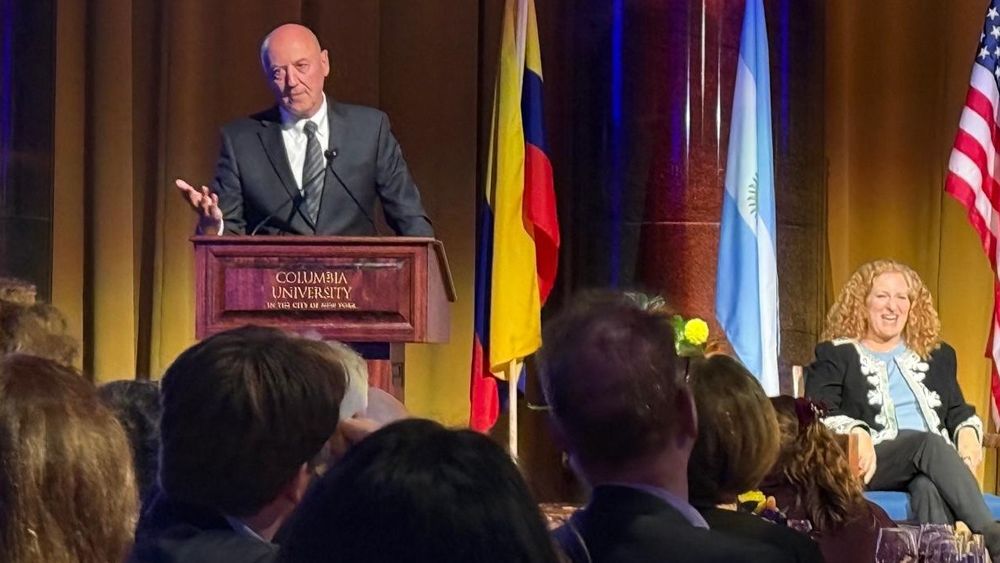
I thank the Inter American Press Association for this invitation and all those who continue to believe—sometimes against all odds—that without a free press, democracy cannot exist.
As the first woman to serve as Deputy Secretary General of the Organization of American States, it is particularly gratifying for me to accompany the IAPA, a hemispheric reference in the defense of press freedom, at this annual meeting, especially since just a few months ago an agreement was signed with the Inter-American Commission of Women of the OAS—the first intergovernmental body in the world created to guarantee women’s human rights. Its purpose is clear: to promote gender equality, strengthen freedom of expression, and combat gender-based disinformation in the Americas.
I express special recognition to the people and government of the Dominican Republic, host country of this Assembly, which in 2025 was recognized by Reporters Without Borders as the country with the highest press freedom index in Latin America.
President Abinader, this achievement honors your commitment to pluralism, transparency, and respect for journalistic work.
From this premise, I stand before you today in my three identities: as a diplomat, as a journalist, and as a woman—three conditions that, if we are honest, are high-risk in today’s world. I could say that you are hearing from a professional of multiple risks: a woman who has made the microphone, the word, and dialogue her tools of work—and, at times, her battlefields.
For decades, I worked as an opinion journalist and as a critic of the media, diplomacy, and multilateralism. Today, at the top of the OAS, I remain the same person: what I once preached from the outside, I now not only say but strive to practice from within.
We are in crisis, ladies and gentlemen, you and us. You, the media, and we, the multilateral organizations.
Allow me to highlight the symmetry between multilateralism and the media. Both are accused of having lost their way. Both are told they no longer represent anyone. Both are asked—sometimes angrily, sometimes wistfully—what are you good for?
Neither multilateralism nor journalism was built on the exercise of hard power. They have no armies or coercive forces. They are founded on trust. The media depend on their credibility before society; the Organization of American States, the United Nations, and the entire multilateral system depend on the authority conferred by state implementation—something achievable only through legitimacy.
If the media are the space where societies see themselves, multilateralism is where nations strive to understand one another.
Both rest on the conviction that truth and cooperation are not naïve aspirations but practical necessities. For Gabriel García Márquez, “a journalist is someone who distinguishes truth from noise.” In a way, the same could be said of a multilateralist. Our work consists of distinguishing between principles and interests, dialogues and monologues, consensus and convenience.
But that belief in truth and cooperation is what is eroding. We live in an age that distrusts intermediaries—those who stand between citizens and power, or between one nation and another. People say: “I don’t need journalists; I have social media—and now, artificial intelligence.” Governments say: “I don’t need to fund multilateral bodies; I can do everything bilaterally.” In both cases, we end up in the same place: fragmented, overwhelmed by noise, and utterly alone.
The press and multilateralism are accused of similar sins—elitism, bureaucracy, slowness. But in reality, both defend something deeply subversive: the idea that facts must be verified, that words must have consequences, that decisions must be discussed. Both defend slowness in an age of acceleration, procedure in an age of improvisation, dialogue in an age where shouting is mistaken for clarity.
What we face is not only a crisis of legitimacy, but one of meaning.
Societies no longer agree on what truth is, and states question the postwar institutional order.
The media face a battlefield of narratives; multilateralism faces a battlefield of sovereignties. Yet, both fight for the same thing: the possibility of a shared reality. Without it, there is no journalism—and without it, no diplomacy.
Both are imperfect. Both are, frankly, often exasperating. But both are indispensable to democracy. Journalism stands as the conscience of democracy, and democracy without multilateralism becomes reckless.
Albert Camus wrote, “Freedom is nothing but a chance to be better.” This is true for people and for institutions. Both the press and multilateralism must use the freedom this new world—with its technologies—offers us: to become better, to act with greater transparency, to regain relevance. Our task is not to defend institutions as they are today, but to reimagine them, acknowledging our mistakes, valuing what we have left behind, and drawing closer to the people whose trust we must rebuild.
For journalists, that means listening more attentively, more respectfully, more empathetically.
For multilateralists, it means proving that cooperation yields tangible results—that it goes beyond words, even amid the sharpest differences. Both must speak with humility, not authority.
And perhaps—just perhaps—we can learn from one another. The journalist can remind the diplomat that words only matter if they touch someone’s life. And the diplomat can remind the journalist that freedom of expression only survives when dialogue is preserved. After all, we are on the same side: the side of reason, of understanding, of knowledge. If we lose faith in the press and in multilateralism, we abandon the idea that deliberation can still change things. But if we protect them—not as relics, but as acts of resistance—then perhaps we defend the most revolutionary idea of all: that truth and cooperation still matter, even when they go out of fashion.
And perhaps that is where we must return—to the basics. To the essential. To the simple yet demanding things that first gave the press and multilateralism their meaning: telling the truth, returning to dialogue, keeping our word, listening before speaking, serving with dedication. The public interest—our shared cause.
For both multilateralism and the media, the essential also means inclusion. Legitimacy is earned not only through ethics, but through representation. I say this as the first woman to hold this office, fully aware that legitimacy requires that all sectors, all voices, all genders—not only be present, but influential. Equality is not a favor. It is part of the architecture of trust. Equality is not a marginal agenda; it is the foundation upon which every democracy and every lasting form of leadership is built.
Let us not take refuge in nostalgia for the past. Let us commit to discipline. For multilateralism, that means austerity, transparency, and accountability—not as slogans, but as daily practice. Austerity in privilege, transparency in process, accountability in purpose—all to demonstrate that cooperation is not theater, but service.
For the press, it means recovering the line between information and opinion, restoring civility as a professional virtue, and rediscovering that journalism can be rigorous without being inhuman, critical without being insulting. Credibility is born not of volume, but of integrity.
You and we have left promises unfulfilled. Only if we recognize that we have a problem and face it together can we grow stronger. Let us restore deliberation to our institutions, to our journalism, to our democracies. If we do—if we stop being distracted by noise and vanity and return to what is essential—then we will not need to shout for lost legitimacy in every meeting, every space, every newspaper, every broadcast. It will be earned again, where it truly matters in the eyes of the people.