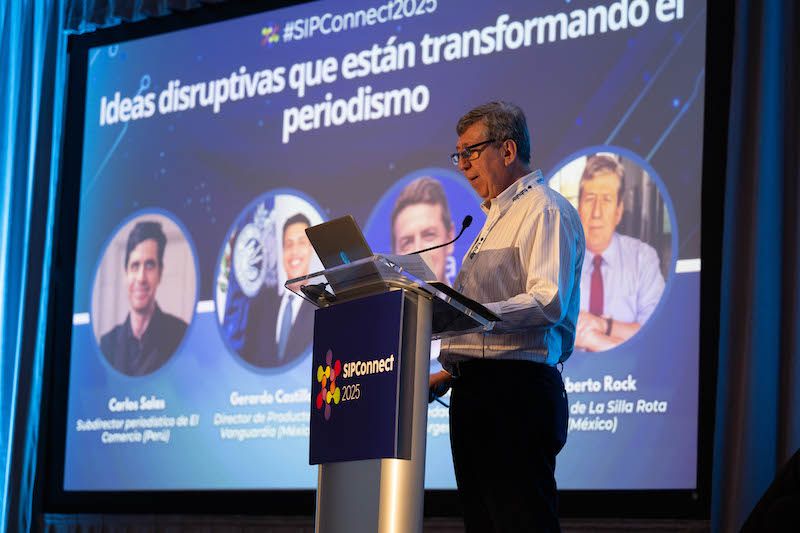
Miami (July 16, 2025) — Roberto Rock, director of La Silla Rota in Mexico and former president of the Inter American Press Association (IAPA), moderated the opening panel of the SIPConnect 2025 conference. Alongside him were Carlos Salas, deputy editorial director of El Comercio, Peru; Gerardo Garza Castilla, product director at Vanguardia, Mexico; and Gastón Roitberg, managing editor of La Nación, Argentina. Together, they discussed the disruptive ideas transforming journalism across Latin America.
Salas from El Comercio explained how the newsroom has integrated artificial intelligence tools through a partnership with the AI engine Perplexity. Media outlets, he noted, are facing challenges such as audiences overwhelmed by waves of misinformation, the rise of personal brands over traditional outlets, and declining web traffic in favor of other platforms. In response to this complex landscape, El Comercio has focused on strengthening trust in its brand, enhancing unique content, and expanding its user base.
Internally, they created a Media Lab, which has established guidelines for AI use, formed partnerships with media outlets and universities, conducted newsroom training, and developed projects such as Merlín, a search engine that provides access to El Comercio’s archives spanning its 186 years of operation.
Roitberg, from La Nación, Argentina, explained that their outlet uses AI to automate daily tasks, and when it comes to article generation, it is done under editorial supervision. He also mentioned they have a publicly available guide for AI usage to ensure transparency.
The rise of AI raises many questions, Roitberg said — such as which tasks will remain exclusively human, what journalism’s unique value proposition will be, and how to ensure algorithms do not perpetuate bias or silence voices.
“Our model is called informational integrality,” he said. “We have a 360-degree team of journalists, designers, editors, programmers, and data specialists to analyze, report, and investigate. Creativity combined with data is the new formula for communication.”
Lastly, Garza Castilla from Vanguardia, Mexico, stated that generative AI is the most significant societal shift we are currently facing. “We have to be revolutionary in how we create content and get closer to our audiences,” he urged. In this context, he emphasized that earning user trust requires high-quality, relevant, structured, and optimized content.
Garza Castilla stressed that technological change hits traditional media especially hard, as they struggle to differentiate their content and make it stand out amid the noise of social media. One innovative solution introduced by Vanguardia was a game that teaches journalism to children through AI. This editorial experiment aimed to “plant the seeds of future readers.” Each child was assigned an editor by the newspaper, and all the stories they created were published.
“If we don’t plant readers today, we’ll reap apathy tomorrow,” Garza Castilla affirmed.
The IAPA is a non-profit organization dedicated to defending and promoting freedom of the press and expression in the Americas. It comprises more than 1,300 publications from the western hemisphere and is based in Miami, Florida, United States.