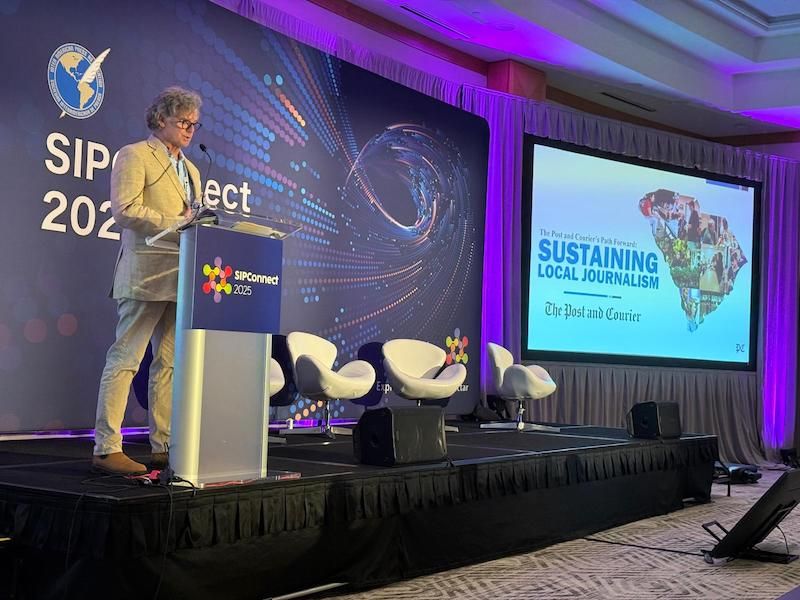
Miami (July 18, 2025) – Amid the rise of news deserts and the crisis of traditional revenue models, a bold approach from South Carolina is making a difference. During the SIPConnect 2025 conference, organized by the Inter American Press Association (IAPA), Pierre Manigault, president of Evening Post Publishing Inc. and first vice president of the IAPA, presented a success story that combines innovation, philanthropy, and community to keep local, independent journalism alive.
Manigault shared the details of this hybrid model, which has raised more than $5 million since 2021 to support independent, quality journalism in his state.
“Good journalism is expensive,” Manigault stated. “And we knew we couldn’t make that investment alone.” In response to the decline in traditional revenues, his organization chose to engage the community through philanthropic funds managed by independent foundations, enabling support for investigative journalism and topic-specific coverage without compromising editorial independence.
One of the flagship projects is “Uncovered”, a series launched in 2021 in partnership with 18 local newspapers to investigate government corruption. The initial goal was to raise $100,000 in 100 days, but the campaign exceeded all expectations, bringing in over $500,000 thanks to strong public support.
The model has evolved to include thematic labs such as Rising Waters (focused on climate change) and an Education Lab, funded with $1.3 million from community leaders. An Arts Lab will soon be added in direct response to audience demand.
Manigault also highlighted partnerships with seven state universities, which have enabled the incorporation of 37 interns into newsrooms and access to free office space, valued at $430,000 annually. “We are training the future generation of local journalists,” he said.
The IAPA’s first vice president emphasized that all funds are used exclusively for journalistic purposes and that donors have no editorial influence. “We don’t sell favors. We make it clear from the start that their contributions do not influence our editorial decisions,” he stressed.
The model has also attracted support from foundations like Knight, companies such as Google and Meta, and organizations like Report for America, building a network of support that is now seen as a case study for local media across the country.
In a context where many media outlets are being sold to conglomerates with interests far removed from the communities they serve, Manigault defended his decision to remain independent: “We’re not looking to get rich. I don’t take a salary, and there are no dividends. But we believe this model can keep good journalism alive in South Carolina for generations.”
The presentation concluded with a call to strengthen audience engagement through local events, newsletters, and full transparency in the use of funds. The message was clear: local journalism can survive—if the community embraces and supports it.
The IAPA is a non-profit organization dedicated to defending and promoting freedom of the press and expression in the Americas. It comprises more than 1,300 publications from the western hemisphere and is based in Miami, Florida, United States.