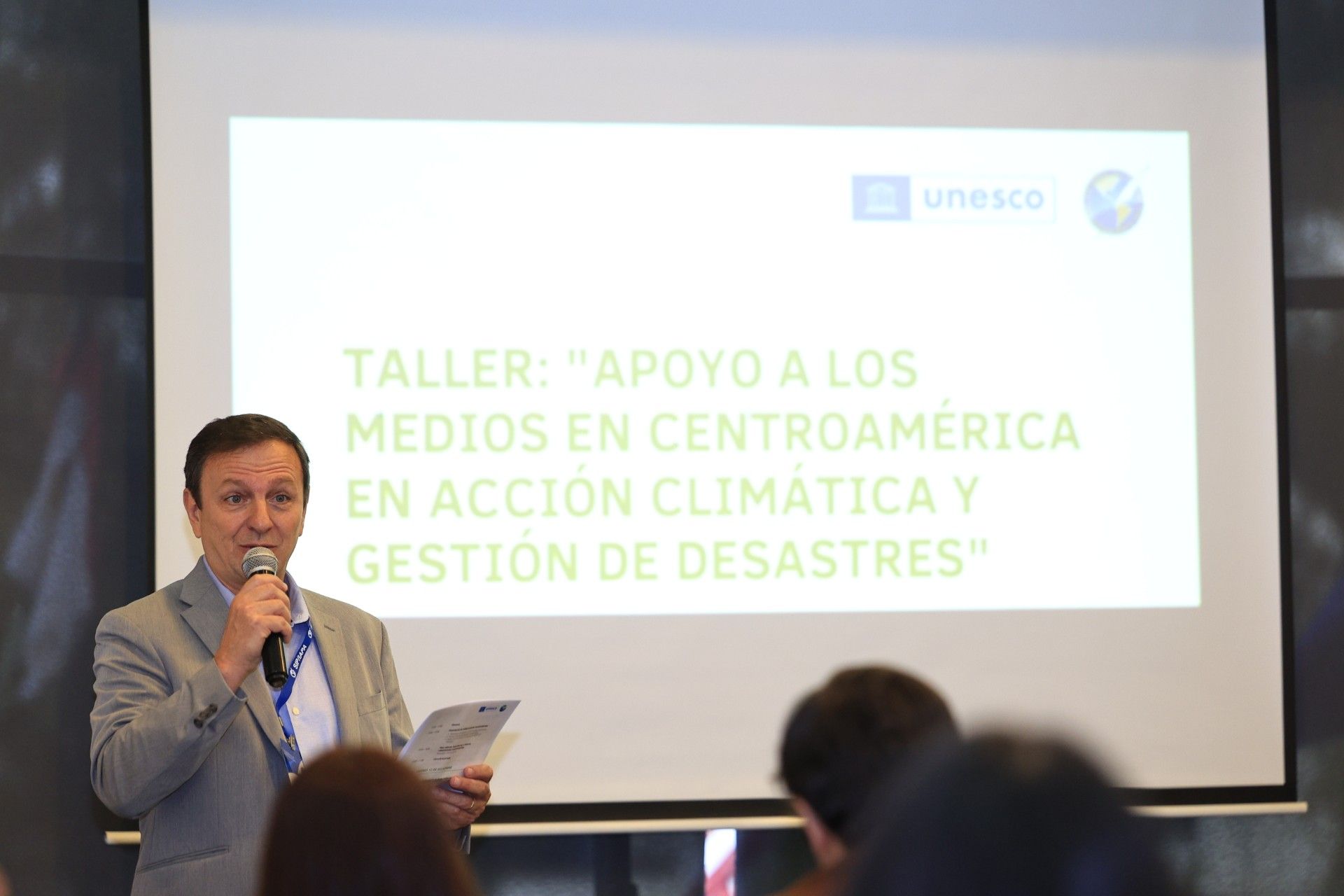
The initiative focused on the Central American Dry Corridor, one of the regions most vulnerable to climate change, extreme weather events, environmental degradation, and capacity gaps. Through training, mentorship, and cross-border collaboration, the program strengthened participating media’s ability to cover climate impacts, public health risks, and disasters while implementing UNESCO’s Model Disaster Preparedness and Response Plan for Media Institutions within their news organizations.
Across borders and formats, journalists demonstrated how climate change is no longer a distant threat, but an immediate and accelerating force reshaping livelihoods, health systems, ecosystems, and migration patterns throughout the region.
One of the most striking collaborations, produced by MalaYerba and El Heraldo documented the reemergence of the screwworm parasite, previously eradicated in the 1990s, now spreading rapidly across Central America and Mexico. Through field reporting in rural communities, hospitals, and cattle ranches, the team exposed the intersection of climate change, illegal cattle routes, weak surveillance systems, and public health failures, exacerbating the epidemic.
Using official data from the U.S. CDC and on-the-ground investigations, journalists identified more than 135,000 animal cases and nearly 1,000 human infections by late November 2025—figures that signal a regional crisis exceeding current response capacities. The investigation also revealed data opacity, underreporting, and fear of retaliation, particularly in El Salvador under the state of exception.
Human stories underscored the urgency: from ranchers afraid to report outbreaks to tragic medical cases, including the death of a newborn in Honduras due to delayed treatment. The reporting highlighted the collapse of regional sterile-fly production capacity and the lack of coordinated policy responses, raising critical questions about preparedness in a warming region.
“This is not an isolated outbreak; it is advancing faster than health systems can track,” the team concluded in a documentary teaser presented during the workshop.
Through long-form television reporting, drone imagery, photography, and digital storytelling, Guatemalan journalists from Prensa Libre and Guatevisión documented how the Dry Corridor has nearly doubled in size over the past decade, expanding from approximately 42 to more than 80 municipalities.
Reporting from San José Las Pilas (Jalapa), the team showed how communities now face nine to ten months of drought per year, severe crop losses, infrastructure neglect, and forced migration—especially of women toward urban centers. Yet the coverage also emphasized solutions journalism, highlighting locally driven adaptation strategies such as rainwater harvesting, micro-irrigation, and small-scale aquaculture supported by international cooperation partners.
Visual evidence of vegetation loss, shrinking yields, and semi-arid expansion transformed abstract climate data into tangible reality, reinforcing the role of high-quality journalism in climate literacy and accountability.
“The Dry Corridor is not shrinking; it’s getting bigger,” the team noted. “Resilience comes from community coordination, not political promises.”
A 21-minute documentary and accompanying radio series examined the Lempa River basin, a lifeline for more than 4.2 million people across Guatemala, Honduras, and El Salvador. The investigation, conducted by Radio Cadena Voces and ARPAS, documented declining water flow, rising temperatures, biodiversity loss, and at least seven major sources of contamination, including agro-industrial waste, untreated sewage, mining, deforestation, and sedimentation.
The reporting centered women leaders in the Bajo Lempa region, who organize community adaptation amid state neglect, environmental damage, and criminalization. Testimonies revealed the gendered burden of climate impacts, from water scarcity to health crises, and the urgent need for sustained media attention.
“The Lempa will end little by little—and we are ending it ourselves,” one community member warned.
From Reporting to Preparedness: Building Resilient Newsrooms
On the second day of the workshop, participating outlets presented tailored institutional disaster preparedness and response plans developed based on UNESCO’s model, adapted to diverse realities—from large multimedia newsrooms to community radio networks and exiled media.
Key advances included:
- Operational continuity plans with backup power, alternative transmission sites, and redundant connectivity
- Clear chains of command and coordination with emergency agencies and other DRR actors
- Trauma-sensitive editorial policies and ethical guidelines for disaster coverage
- AI-assisted verification protocols to counter disinformation during crises
- Commitment to leaving no one behind in disaster reporting
- Safety and mental health measures, especially for journalists working under threat or in exile
These plans demonstrated that preparedness is not abstract policy but a practical, lifesaving tool for both media institutions and the communities they serve.
“A society that is well informed avoids deaths during disasters,” one newsroom stated.
Throughout roundtable discussions, journalists emphasized that one of the program’s greatest achievements was the creation of a living cross-border media network. Despite challenges—restricted access to information, hostile environment, financial constraints, surveillance, and exile—participants agreed that collaboration amplified impact, revealed regional patterns, and strengthened professional solidarity.
“An investigation is stronger when it is replicated across borders,” participants noted.
The IAPA underscored that no story is worth a life, and alongside UNESCO, reaffirmed its commitment to journalist safety, ethical standards, and sustained support for media in vulnerable regions and high-risk environments.
A Model for the Future
The program concluded with concrete recommendations to media development partners, including sustaining the regional network, expanding safety and mental health support, strengthening the use of digital technologies, and funding community-centered climate solutions journalism.
Strategic Outcomes
- High-impact cross-border investigations linking climate, health, environment, and governance
- Strengthened institutional resilience through customized institutional disaster preparedness and response plans
- Deeper regional ties enabling future collaborations and shared defense against disinformation and threats
As the workshop closed, IAPA and UNESCO confirmed their intention to continue generating visibility materials and to build on this initiative as a model for climate journalism, disaster preparedness, and media resilience in Central America.
Beyond borders, Central American media are proving that collaboration, preparation, and quality reporting are essential for confronting the climate crisis—today, not tomorrow.
The IAPA is a non-profit organization dedicated to defending and promoting freedom of the press and expression in the Americas. It comprises more than 1,300 publications from the western hemisphere and is based in Miami, Florida, United States.