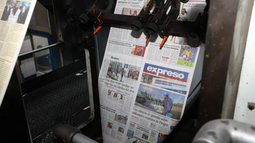
Repression is sustained by a judiciary subordinated to the executive branch. Judges are appointed discretionarily, act in line with directives from high-ranking officials, and have become instruments of political retaliation and asset seizure. This is illustrated by the defamation case brought by Diosdado Cabello against the newspaper El Nacional, which resulted in the confiscation of its facilities, as well as the expropriation and looting of private assets linked to family members of the outlet, under the direct supervision of judicial authorities.
Under current conditions, freedom of expression remains effectively nonexistent in practice. Without a structural transformation of the political and judicial system, no democratic transition will be viable, nor can the fundamental right to information be guaranteed.
Timeline of key developments:
On October 23, Yorbin García, a contributor to the digital outlet Palpitar Trujillano, detained on October 18, was transferred from the headquarters of the Bolivarian National Intelligence Service (SEBIN) to Yare II prison. He appeared in court on October 21, charged with incitement to hatred, treason, and resisting authority.
On October 27, Omario Castellanos, a reporter for SoyLarense, who was detained on October 17 along with his mother Blanca Guerrero and his brother José Castellanos, was brought before a court with jurisdiction over terrorism and charged with terrorism, incitement to hatred, criminal association, and treason.
On October 30, journalist Joan Camargo was riding a motorcycle when he was intercepted by unidentified individuals dressed in black, who forced him into a vehicle. He was released on November 4 after five days of disappearance.
On November 1, relatives of journalist Leandro Palmar and media worker Belises Cubillán reported their transfer to the Aragua Penitentiary Center, known as Tocorón prison. Both had been detained on January 9, 2025, after covering a post-election protest.
Between November 3 and 9, the radio stations Cumanesa 105.3 FM and +Network 89.3 FM in Cumaná, Sucre state, were shut down after CONATEL initiated administrative proceedings. Both had been on air for around 30 years.
On November 12, Omario Castellanos was transferred from detention cells in Lara state to Yare III prison in Miranda state. He suffers from venous insufficiency, a condition that worsened during his detention.
On November 25, CONATEL shut down the radio station 93.7 FM La Radio Se Oye in Vargas municipality, La Guaira, and seized its equipment, leaving more than 20 workers unemployed.
On December 3, journalist José Serna of Noti 365 was arrested at his workplace in Cabimas, Zulia state.
On December 10, a reporting team from the Argentine news channel C5N was expelled from Venezuela.
On December 11, a Chilevisión team was detained for seven hours by intelligence agents at the Colombia–Venezuela border; their phones were confiscated, searched, and media files deleted.
On December 16, the National Union of Press Workers (SNTP) reported the disappearance of political analyst Nicmer Evans, who had been taken without a court order for a supposed “interview.”
On January 5, SNTP called for the release of 23 journalists and the unblocking of more than 60 censored media outlets. That same day, 14 journalists were detained in Caracas during the installation of the National Assembly; 13 were released and one deported.
In the border area between Cúcuta, Colombia, and San Antonio, Venezuela, a Spanish and a Colombian journalist were detained and later released.
On January 7, Colombian journalist Jeff Martínez and Mexican journalist Julián Mazoy were reported missing after attempting to cross the border.
That same day, CONATEL ordered the shutdown of Impacto 105.3 FM in Táchira state after its license was not renewed.
On January 8, journalist and political leader Biagio Pilieri was released after one year and four months in detention.
On January 9, a Telemundo crew was detained for 20 minutes near the U.S. Embassy in Caracas and forced to delete recorded material.
On January 10, one week after Maduro’s capture, further detentions, deportations, and acts of censorship were reported, including the deportation of 13 foreign journalists and the denial of entry to hundreds more.
On January 13, the Inter-American Commission on Human Rights (IACHR) and its Special Rapporteur for Freedom of Expression warned about restrictions on access
On January 14, the following journalists were released from detention: Ramón Centeno, detained on February 2, 2022; Leandro Palmar and camera assistant Belises Cubillán, detained on January 9, 2025; Víctor Ugas, detained on August 18, 2024; Carlos Marcano, detained on May 23, 2025; Rafael García Márvez, detained on July 22, 2025; Roland Carreño, detained on August 2, 2024; Julio Balza, detained on January 9, 2025; Nakary Ramos Mena and her husband, along with camera assistant Gianni González, detained on April 8, 2025; Gabriel González, detained on June 27, 2024; Carlos Julio Rojas, detained on April 15, 2024; Luis López, detained on June 14, 2024; Nicmer Evans, detained on December 13, 2025; Mario Chávez Cohen, detained on May 6, 2025; Carlos Lesma, detained on October 9, 2025; Ángel Godoy, detained on January 8, 2025; Omario Castellanos, detained on October 16, 2025; and Yorbin García, detained on October 18, 2025.
On January 24, an appeals court overturned the 15-year sentence of journalism student Juan Francisco Alvarado, who was released the following day.
On January 30, Venevisión reported being removed from free-to-air and satellite channel lineups.
On January 31, Unika 92.1 FM in Caracas was shut down after 19 years on air.
On February 3, the Special Rapporteur expressed concern over continued restrictions on recently released journalists.
On February 4, journalist Álvaro Algarra was detained, and Rory Branker, editor of La Patilla, was released after nearly a year in prison.
On February 9, the SNTP presented a comprehensive amnesty proposal including persecuted journalists.
On February 20, CONATEL, accompanied by National Guard forces, shut down Urbana 94.3 FM in Miranda state.
On February 22, journalist and comedian Deivis Correa was granted full release.
On February 23, courts with jurisdiction over terrorism refused to accept amnesty-related case dismissals submitted by journalists.
On February 24, journalist Marifel Guzmán was released, and the SNTP requested a review of 40 cases.
On February 25, the Alliance for Freedom of Expression called for the unblocking of websites and social media platforms.
On February 26, journalists Pedro Urribarri and Jonathan Carrillo were released.
On February 27, CONATEL shut down Rítmica 104.1 FM in Carabobo state, seizing its equipment.
On March 2, National Assembly President Jorge Rodríguez stated that journalism could now be practiced without fear of reprisals.
On March 3, journalist Walter Jaimes was murdered in Mérida state; authorities later attributed the crime to personal motives.
On March 4, journalist Carlos Marcano was granted full release, and for the first time in over a decade, independent media were allowed access to the Miraflores presidential palace press room.
On March 5, journalist Julio Balza reported being under surveillance near his home.
On March 14 and 16, amnesty was denied to journalist Nakary Ramos and audiovisual producer Gianni González.
On March 16, journalist Carlos Julio Rojas reported that at least 15 journalists and hundreds of political prisoners remained without resolution or had been denied amnesty.
On March 18, the National College of Journalists (CNP) denounced a government plan to graduate “fake journalists” and warned of increasing media control. That same day, El Nacional director Miguel Henrique Otero reported the seizure of assets from his family residence under a prior court order.