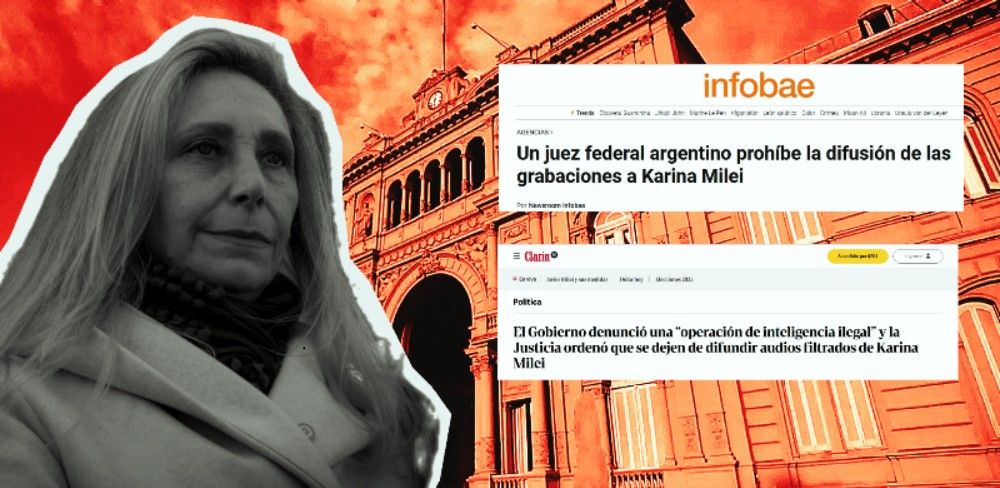
Miami (September 3, 2025) — The Inter American Press Association (IAPA) warned that a recent court ruling in Argentina prohibiting the dissemination of audio recordings attributed to Presidential General Secretary Karina Milei sets a dangerous precedent for freedom of expression and public access to information. The organization also condemned a request by the Ministry of Security to raid a news outlet and the homes of two journalists.
On September 1, Judge Alejandro Patricio Maraniello of Federal Civil and Commercial Court No. 5 in Buenos Aires issued a precautionary measure banning the distribution of the audios “through any written or audiovisual media, social networks, platforms, or web channels.”
The judge partially granted a petition by President Javier Milei’s sister. The recordings, reportedly made inside the Casa Rosada, were broadcast on August 29 by the streaming channel Carnaval.
IAPA President José Roberto Dutriz said the ruling amounts to prior censorship, “expressly prohibited by Argentina’s Constitution and by the American Convention on Human Rights.” Dutriz, CEO and general director of La Prensa Gráfica (El Salvador), stressed: “Blocking journalists, media, and citizens from sharing or debating public-interest issues undermines society’s right to be informed and sets a dangerous precedent for democracy. Extending the prohibition to social media and digital platforms aggravates the restriction and fuels self-censorship.”
Martha Ramos, chair of the IAPA’s Committee on Freedom of the Press and Information and editorial director of Organización Editorial Mexicana (OEM), added: “If there are doubts about the authenticity or impact of the audios, authorities should investigate their origin or assign responsibilities afterward. Preventively blocking their dissemination is unacceptable. Transparency and public debate over officials’ actions are pillars of democracy. Silencing the press or citizens is never the answer.”
The Ministry of Security has also asked the courts to raid the homes of journalists Jorge Rial and Mauro Federico, as well as the offices of Carnaval. President Javier Milei claims the audios were obtained illegally and are part of an attempt to destabilize his government ahead of the October 26 legislative elections, according to press reports.
The IAPA stressed that the ruling violates international standards. Principle 5 of the Inter-American Commission on Human Rights’ Declaration of Principles on Freedom of Expression states that “prior censorship, direct or indirect interference, or pressure on any expression or information must be prohibited by law.” Similarly, Principle 5 of the IAPA’s Declaration of Chapultepec rejects “prior censorship, restrictions on circulation, obstacles to the free flow of information, or limitations on the work of journalists.”
Argentina’s Association of Journalistic Entities (ADEPA) and the Argentine Journalism Forum (FOPEA) also strongly rejected the ruling, recalling that journalists may only be subject to subsequent civil or criminal liability, never to prior restrictions on publication.
The IAPA is a non-profit organization dedicated to defending and promoting freedom of the press and expression in the Americas. It comprises more than 1,300 publications from the western hemisphere and is based in Miami, Florida, United States.