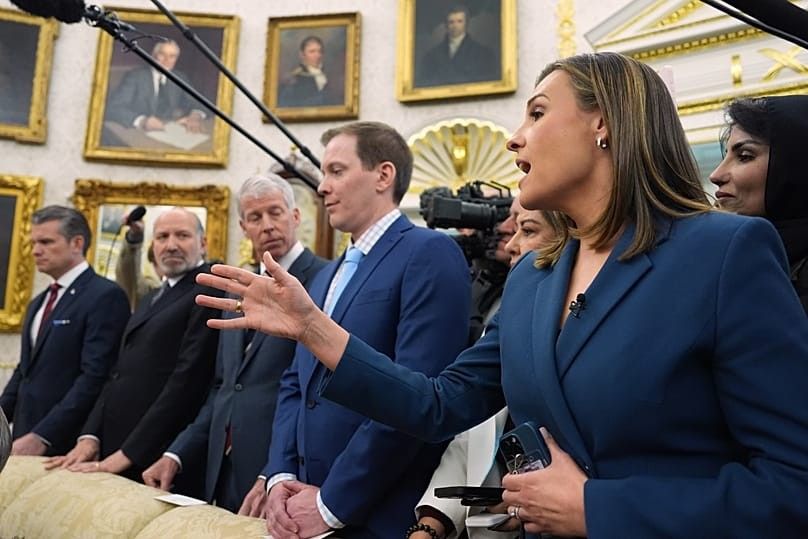
Miami (December 9, 2025) — The Inter American Press Association (IAPA) expresses its deep concern over the consequences of President Donald Trump’s ongoing verbal attacks against women journalists in recent months. Such disparaging remarks from a position of power contribute to fostering a hostile environment for the practice of journalism, endanger the safety of women reporters, and undermine the democratic principles on freedom of expression.
In recent weeks, President Trump has verbally attacked, mocked, belittled, and disqualified women journalists who question him on matters of public interest, according to press reports.
On various occasions, the U.S. president has used several insults to demean women journalists, calling them “piggy,” “stupid,” “ugly inside and out,” “hateful,” and a “terrible reporter,” in reference to reporters from CBS, Bloomberg, The New York Times, and ABC News, among other outlets he has labeled as part of the “fake news.” Meanwhile, there has been no apology from the president or his administration, according to press reports.
“Women journalists have the right — and the responsibility — to ask questions, hold governments accountable, and demand transparency without being subjected to personal attacks, denigrating comments, or attempts to discredit their work,” said IAPA President Pierre Manigault. “When such aggression comes from authorities, the impact is even more serious: it sends a message of intolerance toward the press and legitimizes harassment that can escalate into more serious forms of violence.” Manigault is also chairman of the Evening Post Publishing Inc. group in Charleston, South Carolina, United States.
Martha Ramos, chair of the IAPA’s Committee on Freedom of the Press and Information, added that “the IAPA categorically rejects any behavior aimed at intimidating or undermining the work of women journalists and reminds the public that democratic leadership requires respect for press freedom, even — and especially — when faced with critical questioning.” Ramos, editorial director of the Organización Editorial Mexicana (OEM), reaffirmed the organization’s solidarity “with all women journalists who have been targets of public attacks” and reiterated the IAPA’s commitment “to defending a safe environment, free from harassment and discrimination, for the practice of journalism.”
The IAPA officials recalled that the organization’s message for International Women’s Day last March underscored that “we are facing a complex and challenging scenario. Instead of consolidating and deepening the achievements made, we face a wave of setbacks driven by the advancement of conservative sectors and the reorganization of anti-rights groups.”
A study published this month by UN Women, “Tipping Point: The Chilling Escalation of Online Violence Against Women in the Public Sphere,” which includes testimony from more than 6,900 women — including journalists, human rights defenders, and activists — across 119 countries, revealed that in 2025 the percentage of women journalists who reported links between offline physical attacks and online violence rose to 42%, more than double the rate in 2020.
The report concluded that digital violence is no longer “virtual”: online threats lead to real-world consequences; they impede women’s participation in public life and in the press and erode freedom of expression.
The IAPA is a non-profit organization dedicated to defending and promoting freedom of the press and expression in the Americas. It comprises more than 1,300 publications from the western hemisphere and is based in Miami, Florida, United States.