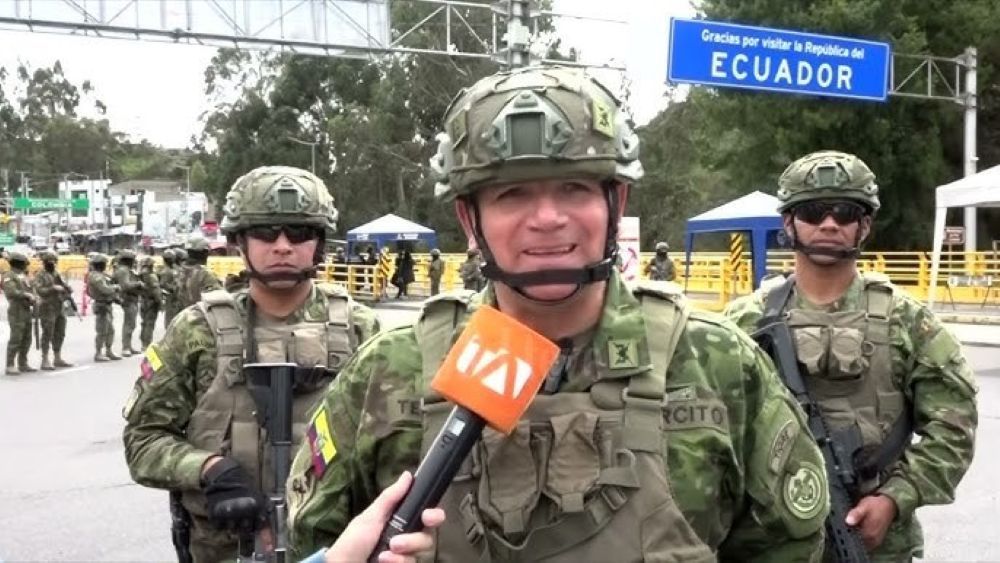
Miami (February 11, 2026) – The Inter American Press Association (IAPA) expresses its deep concern over guidelines issued by the Joint Command of the Armed Forces of Ecuador (FF.AA.) for the coordination, accreditation, and management of media outlets and journalists at institutional events. The organization believes these measures establish a system of control, evaluation, and exclusion that amounts to prior censorship and an illegitimate restriction on the practice of journalism.
The organization warns that conditioning media and journalists’ access to public information based on their editorial line, past coverage, or position regarding a state institution directly violates constitutional principles, the Declaration of Chapultepec, and Inter-American human rights standards, which prohibit all forms of censorship and require states to guarantee a free and pluralistic environment for journalistic work.
According to information reported on February 10 by the television network Ecuavisa and other local media, the guidelines establish “previously defined technical criteria” to authorize or deny accreditations, including the evaluation of a media outlet’s editorial line, its historical coverage of the Armed Forces, and its alleged alignment with the institution’s mission and values. They also contemplate the assignment of scores, the creation of internal records, and the classification of media as “aligned, neutral, or critical,” in order to justify decisions of inclusion or exclusion.
Following the publication of these provisions and the backlash from various sectors, the Armed Forces issued a clarification stating that the guidelines are not intended to restrict journalistic work, but rather to organize coverage and ensure security at official events and strategic facilities. However, the IAPA considers that the content of the document contradicts that assertion.
The IAPA obtained access to the official guidelines and found that they provide, among other measures, for avoiding the accreditation of media outlets or communicators whose conduct is deemed “harmful to the institutional image,” establishing periodic evaluations of “informational performance,” and applying strategies to “manage the participation of non-aligned media.” The document even proposes allowing coverage by critical media only at certain symbolic events in order to limit negative narratives and using “selective inclusion” mechanisms as a reputational enhancement tool.
IAPA President Pierre Manigault warned that “no state entity can set itself up as an arbiter of the press or decide which media outlets or journalists are acceptable based on their approach or editorial stance. That amounts to prior censorship, a practice expressly prohibited in a democratic society.”
Manigault, president of Evening Post Publishing Inc., based in Charleston, South Carolina, United States, added that “access to public information must be guaranteed on equal terms. Any system that rates, filters, or excludes media outlets based on the content of their coverage violates the public’s right to be informed.”
Martha Ramos, chair of the IAPA’s Committee on Freedom of the Press and Information, stated that “these guidelines institutionalize a model of control incompatible with democracy and with the watchdog role of the press.” Ramos, editorial director of Organización Editorial Mexicana (OEM), maintained that “the Armed Forces, like any public institution, are subject to independent scrutiny. They are not responsible for evaluating journalistic content or punishing critical journalism.”
Organizations dedicated to defending press freedom and human rights rejected the Armed Forces’ provisions. The Andean Foundation for Media Observation and Study (Fundamedios) warned that “conditioning access to public information and official events based on a media outlet’s editorial content constitutes an act of prior censorship expressly prohibited by the Constitution of Ecuador.” Human Rights Watch, for its part, stated that these “are practices typical of institutions that fear public scrutiny.”
The IAPA is a non-profit organization dedicated to defending and promoting freedom of the press and expression in the Americas. It comprises more than 1,300 publications from the western hemisphere and is based in Miami, Florida, United States.