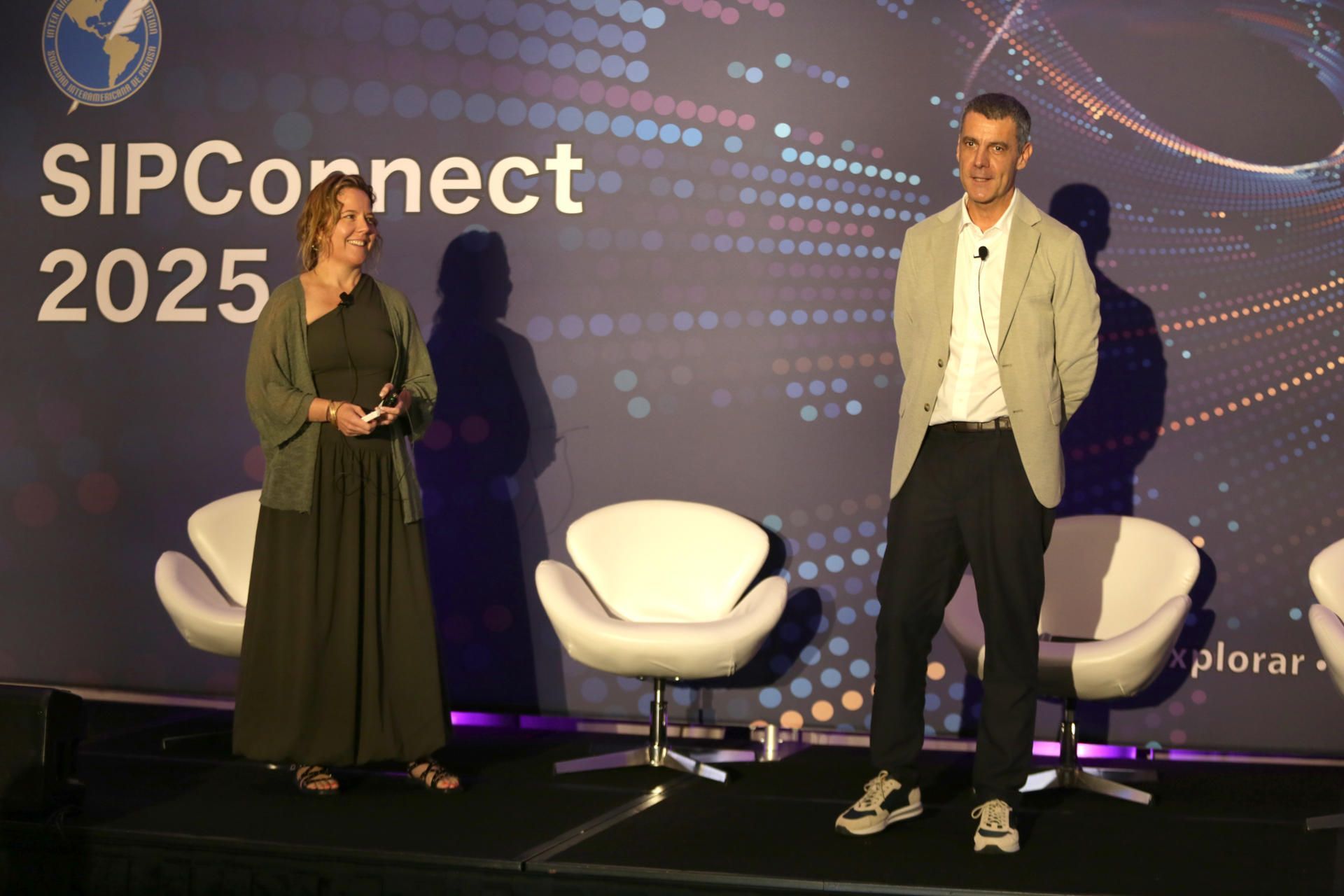
In a talk that blended strategic analysis, revealing data, and a tech-forward vision, Hiberus Media Labs took the stage at SIP Connect 2025 to reflect on the present and future of media. Under the title “Liquid Content for Fluid Newsrooms,” David Sancha, CIO, and Belén Jodar, COO of Xalok, shared key takeaways from major international events and demonstrated how artificial intelligence and shifting consumption habits are reshaping the way news is produced and distributed.
According to Sancha, the phrase “From digital transformation to the transformation of digital” captures a profound paradigm shift. It’s no longer just about adapting to a digital environment—it’s about understanding how digital itself is evolving. This transformation is taking place in two main areas: in relation to audiences and in relation to content production.
The Transformation of Digital in Relation to Audiences
From the world’s leading media events, a key insight has emerged: “Traffic and visits no longer matter; what matters now is audience quality and meaningful reach.” More and more, media outlets are shifting their strategy in that direction, moving away from quantity-based metrics to focus on building stronger, more valuable connections with their audiences.
Nicholas Thompson, CEO of The Atlantic, presented a scenario in which traffic from external platforms drops to zero. Along the same lines, Claudio Cabrera, VP of Audience at The Athletic, stressed the importance of strengthening the product, diversifying distribution channels, and transforming audience relationships to adapt to this new landscape.
Jodar explained that much of this change is being driven by the emergence of AI Overview. This technology allows users to receive direct answers within interfaces like Google, fueling the rise of zero-click searches—queries that don’t result in clicks to media websites—and accelerating the growth of walled gardens, closed ecosystems in which platforms retain and monetize users’ attention.
In this context, Sancha emphasized the need to reinforce a direct and honest relationship with audiences, highlighting three key strategies:
-
Boost subscriptions and memberships using first-party data to build community.
Diversify audience acquisition strategies across multiple channels.
Shift from SEO that drives clicks to SEO that earns citations: aim for relevance in chatbots and AI systems. It’s crucial to be aware of traffic that may come from these emerging sources.
The Transformation of Digital in Relation to Content Production
The concept of liquid content is gaining traction. According to Ezra Eeman, Director of Digital Strategy and Innovation at Dutch public broadcaster NPO, content can now be distributed in three ways:
-
Flow – when a message is delivered in real time and a single format (e.g., a livestream);
File – when the content is static and targeted to a specific channel (e.g., a newsletter or a website article);
Fluid – when AI allows content to adapt flexibly across platforms, formats, and audiences, flowing with users’ habits.
Xalok’s vision is grounded in the idea of a “fluid newsroom”—a model designed to help media organizations adapt to digital transformation and evolving audience relationships through the use of AI. To achieve this, they developed Xalok Assistant, a system that strengthens media products by automatically generating new content formats, diversifying distribution across channels, and—critically—preserving the unique editorial voice of each outlet.
Assistant operates in a secure, managed environment where journalists retain control over when and how to use AI to assist with tasks such as headline creation, entry generation, image production, SEO optimization, and rapid editing. Additionally, the platform streamlines publishing and adapts content to various formats and social networks—always keeping the journalist at the center of the process.
The Hiberus Media Labs team concluded their presentation with a reference to a powerful metaphor: “In a flood, the first thing you look for is drinking water.”
“What you are, and what the IAPA represents, is drinking water. You are professional content, made by professionals, informing your audiences. But it’s not just drinking water for your audiences—it’s drinking water for your societies. From the tech side, we share that principle. We are here to help, whenever we can,” reflected Sancha.